
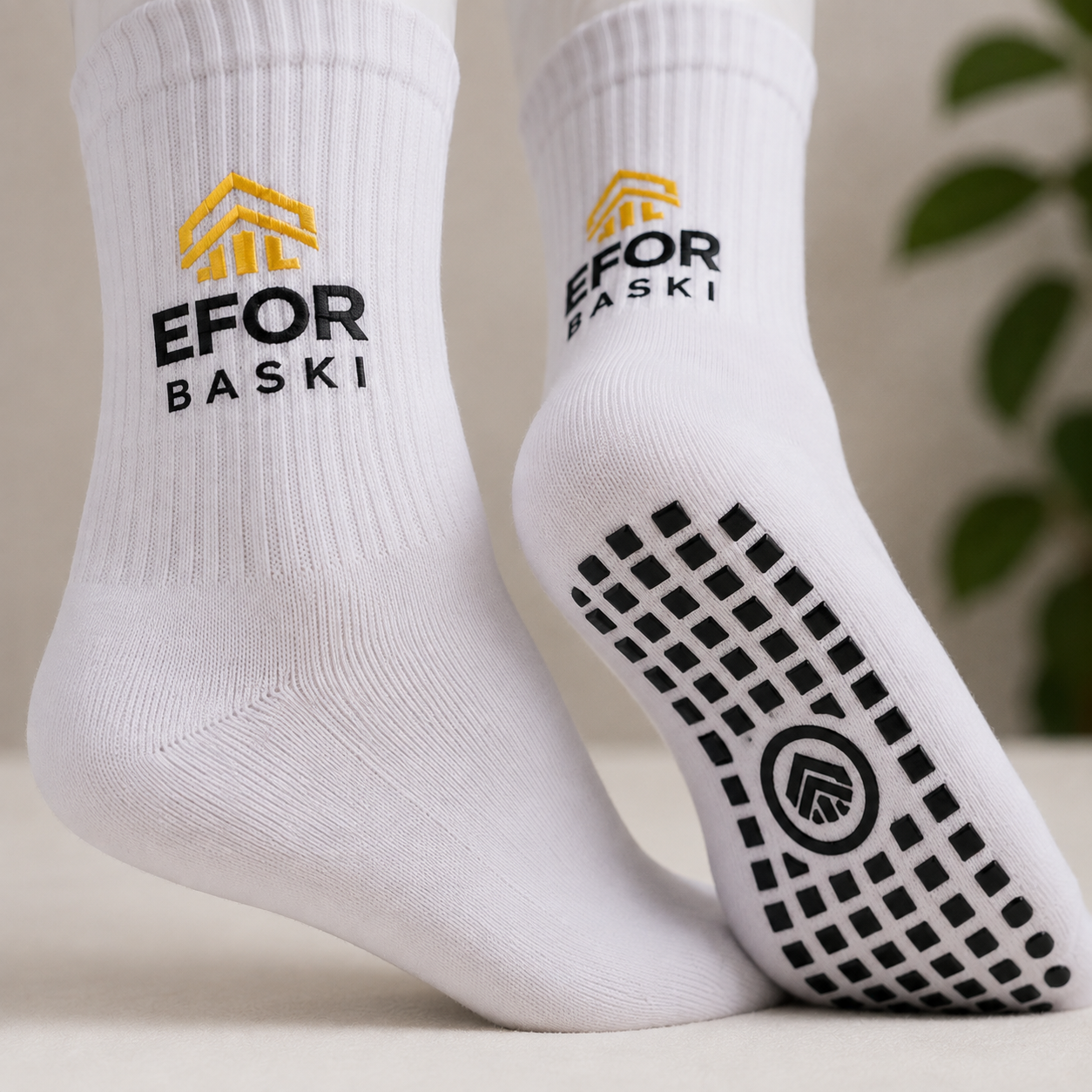
Non-slip sock printing is a specialized textile printing process used to create grip patterns on the soles of socks.
These raised or textured grip areas are designed to increase friction between the sock and surfaces such as floors, exercise equipment or studio environments.
The technology is widely used for products such as yoga socks, Pilates socks, children's socks, indoor socks and other specialized footwear products.
Grip patterns can also become part of the visual identity of the product. Depending on the production process, brands can use custom shapes, patterns, text and logos on the sole of the sock.
In this guide, we explain how non-slip sock printing works, the terminology used in the industry and the factors that should be considered when developing custom grip socks.
What Is Non-Slip Sock Printing?
Non-slip sock printing is the process of applying specialized grip material to selected areas of a sock sole.
The applied material creates a raised or textured surface designed to provide additional grip compared with the untreated textile surface.
The grip can be applied in different patterns, including:
- Dots
- Lines
- Geometric shapes
- Brand logos
- Letters
- Symbols
- Custom patterns
This means the printing can serve both a functional and visual purpose.
How Does Silicone Grip Printing Work?
Silicone grip printing generally involves applying a specialized material to predetermined areas on the bottom of the sock.
The exact process depends on the material, equipment and production system being used.
A typical production workflow may include:
- Grip pattern design
- Artwork preparation
- Sock positioning
- Screen or application preparation
- Grip material application
- Curing
- Quality control
1. Designing the Grip Pattern
The first stage is deciding where the grip areas should be positioned on the sock sole.
A good grip design should consider both appearance and the intended use of the product.
Depending on the sock, the design may cover:
- Heel area
- Forefoot
- Midfoot
- Most of the sole
- Selected contact areas
The size, spacing and distribution of grip elements can affect both the appearance and functional characteristics of the final product.
2. Preparing the Artwork
If the sole design contains a logo, text or custom graphic, the artwork needs to be prepared for the selected production method.
Important factors can include:
- Minimum line thickness
- Spacing between elements
- Logo dimensions
- Print area
- Positioning
Very small or highly detailed artwork may need to be simplified depending on the grip material and application method.
3. Positioning the Sock
Accurate positioning is important because the grip pattern needs to be applied consistently to the sole area.
In professional production, the sock is positioned so that the print area remains stable during application.
Consistent positioning becomes especially important when producing larger quantities.
4. Applying the Grip Material
The selected grip material is applied to the sole according to the prepared pattern.
Depending on the production system, the application may create slightly raised elements on the textile surface.
These elements provide the texture associated with non-slip or grip socks.
5. Curing
After application, the printed material must be cured according to the requirements of the specific system.
Curing conditions can influence:
- Adhesion
- Flexibility
- Surface characteristics
- Wash performance
Correct temperature and curing time are therefore important parts of the production process.
6. Quality Control
After production, the socks should be inspected for consistency.
Quality control can include checking:
- Pattern positioning
- Grip distribution
- Material application
- Visible defects
- Consistency between pairs
- Curing quality
What Is ABS Sock Printing?
The term ABS sock printing is sometimes used in the market to describe non-slip grip applications on sock soles.
However, terminology can vary between manufacturers, countries and production systems.
Terms such as:
- ABS sock printing
- Silicone sock printing
- Grip printing
- Anti-slip printing
- Non-slip sole printing
may be used to describe similar product categories, even though the actual material composition or production process may differ.
Can a Logo Be Printed on the Bottom of Socks?
Yes. Depending on the design and production method, custom logos can be incorporated into the grip pattern.
This allows brands to turn a functional part of the sock into an additional branding area.
Possible applications include:
- Brand logos
- Brand names
- Initials
- Symbols
- Custom graphic patterns
The logo may be repeated across the sole or integrated into a larger grip pattern.
Where Are Non-Slip Socks Used?
Non-slip socks are used in many different product categories.
Pilates Socks
Grip socks are commonly used in Pilates studios where users need additional contact with studio surfaces and equipment.
Yoga Socks
Yoga socks may use sole grip patterns to provide additional friction during movement and different poses.
Children's Socks
Non-slip patterns are also widely used on indoor socks designed for children.
Indoor and Home Socks
Grip applications can be added to socks intended for use on indoor flooring.
Specialized Sports and Fitness Socks
Different grip configurations can also be developed for specialized fitness and performance products depending on the intended application.
What Are the Advantages of Non-Slip Sock Printing?
Grip printing can provide several product development advantages.
- Adds grip characteristics to the sock sole
- Supports custom patterns
- Creates additional branding opportunities
- Can differentiate a product collection
- Can be adapted for different sock categories
- Provides visual and tactile design possibilities
Can Custom Grip Patterns Be Created?
Yes. Custom pattern development is one of the most interesting aspects of sock grip printing.
Instead of using standard dots, brands can create patterns based on their own visual identity.
For example, the grip design can use:
- Repeated logos
- Geometric brand elements
- Typography
- Icons
- Abstract patterns
However, the design must remain technically suitable for the selected printing process.
Is Non-Slip Sock Printing Washable?
Wash performance depends on the material, textile compatibility, curing process and garment care conditions.
Correct production conditions are important for achieving reliable adhesion between the grip material and the textile surface.
Before large-scale production, testing should be performed on the actual sock construction and material.
Is Non-Slip Sock Printing Suitable for Children's Products?
Non-slip sole applications are commonly found on children's socks.
However, products intended for babies and children require particular attention to material selection and applicable product safety requirements.
The materials and production processes used should meet the relevant chemical and product safety requirements of the target market.
Manufacturers and brands should therefore evaluate compliance requirements before production.
What Should Be Considered When Designing Grip Socks?
Several factors should be evaluated during product development:
- Sock material
- Sole dimensions
- Grip pattern
- Pattern density
- Logo dimensions
- Material compatibility
- Curing requirements
- Intended use
- Target market requirements
Functional design and visual design should be developed together rather than treated as separate elements.
Should You Produce a Sample Before Bulk Production?
Yes. Sampling is particularly important for custom grip socks.
A physical sample allows the brand to evaluate:
- Pattern size
- Logo readability
- Print position
- Material application
- Surface texture
- Overall appearance
Testing can also help evaluate the compatibility of the selected grip system with the actual sock material.
What Affects Non-Slip Sock Printing Prices?
The cost of non-slip sock printing depends on the specifications of the project.
Factors may include:
- Order quantity
- Grip material
- Print area
- Pattern complexity
- Number of applications
- Sock construction
- Custom logo requirements
- Production preparation
For accurate pricing, the sock specifications, artwork and required quantity should be evaluated together.
Can Non-Slip Sock Printing Be Produced in Bulk?
Yes. Non-slip grip printing can be integrated into professional bulk sock production.
For larger quantities, production consistency becomes particularly important.
The manufacturer should monitor:
- Print positioning
- Grip pattern consistency
- Material application
- Curing conditions
- Pair-to-pair consistency
Non-Slip Sock Printing for Private Label Brands
Custom grip printing can be particularly useful for private label and fitness brands developing their own sock collections.
The grip pattern itself can become part of the brand identity.
This is especially relevant for:
- Pilates brands
- Yoga brands
- Fitness brands
- Children's clothing brands
- Private label sock collections
- Promotional textile projects
Non-Slip Sock Printing in Turkey
Turkey has a well-established textile manufacturing ecosystem that includes garment, hosiery and specialized textile production.
Brands looking for non-slip sock printing in Turkey should consider both the printing technology and the manufacturer's experience with the specific sock material and intended application.
Sample development and production testing are particularly important before larger orders.
Professional Non-Slip Sock Printing with Efor Baskı
Efor Baskı provides professional textile printing solutions for brands and textile production projects, including specialized printing applications.
For non-slip sock projects, the sock material, grip design, logo, required print area and production quantity can be evaluated before production.
You can also explore our Textile Printing Methods guide and Screen Printing guide to learn more about professional textile printing processes.
For custom non-slip sock printing, silicone grip applications or branded grip sock projects, contact Efor Baskı to discuss your product and production requirements.