
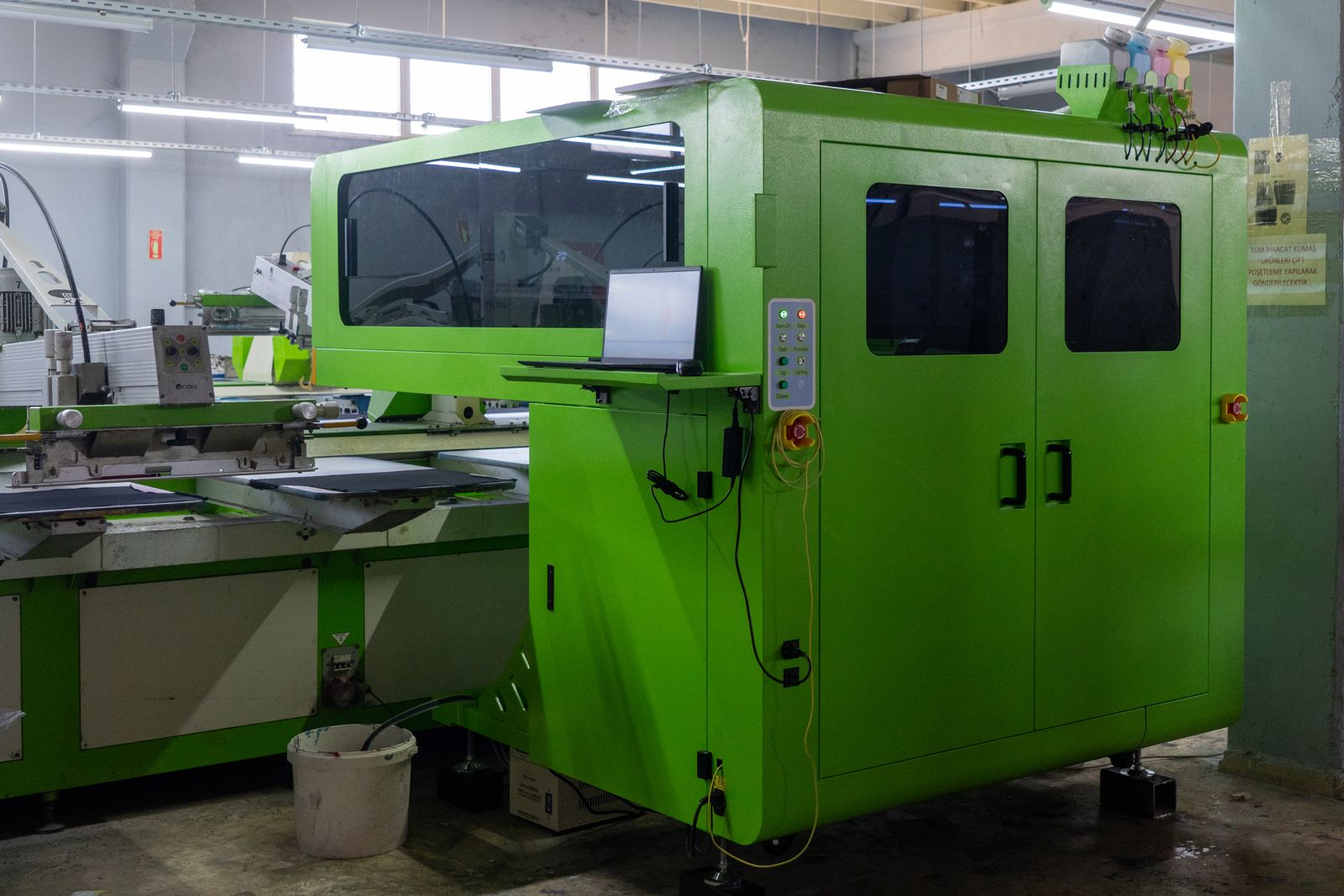
DTG vs DTF printing is one of the most common comparisons for clothing brands, textile manufacturers and businesses looking for professional garment printing.
Both technologies are digital textile printing methods and can reproduce detailed, multi-color artwork. However, they use very different production processes.
With DTG (Direct to Garment), the design is printed directly onto the textile. With DTF (Direct to Film), the artwork is first printed onto a special film and then transferred to the garment.
So, which one is better: DTG or DTF?
There is no single answer that applies to every project. The right choice depends on the fabric, design, order quantity, desired print feel and production requirements.
What Is DTG Printing?
DTG stands for Direct to Garment printing.
It is a digital textile printing technology that applies specialized textile inks directly onto the surface of a garment.
The artwork is sent digitally to the printer and reproduced directly on the textile without using a transfer film.
Depending on the garment and production process, pretreatment may be required before printing. Dark garments typically require a white ink underbase before the colored artwork is applied.
DTG is particularly useful for:
- Detailed illustrations
- Photographic artwork
- Multi-color designs
- Gradients
- Complex graphics
- Fashion and streetwear designs
For a complete explanation of the technology, read our What Is DTG Printing? guide.
What Is DTF Printing?
DTF stands for Direct to Film printing.
Unlike DTG, the design is not initially printed directly onto the garment.
Instead, the artwork is printed onto a special transfer film. An adhesive powder is then applied as part of the production process.
The prepared transfer is subsequently applied to the textile using heat and pressure.
This production method allows DTF transfers to be used on a wide range of textile products when the material and process are compatible.
What Is the Main Difference Between DTG and DTF?
The most important difference between the two technologies is how the design reaches the garment.
DTF: The design is printed onto a film and then transferred to the garment.
This difference affects fabric compatibility, print feel, production workflow and the type of projects for which each technology may be suitable.
DTG vs DTF Printing Comparison
| Feature | DTG Printing | DTF Printing |
|---|---|---|
| Process | Direct printing onto the garment | Printed onto film and transferred to the garment |
| Transfer Film | Not required | Required |
| Fabric Compatibility | Commonly preferred for cotton and cotton-rich garments | Can be suitable for a wider range of textile materials |
| Detailed Artwork | Excellent | Excellent |
| Multi-Color Artwork | Excellent | Excellent |
| Photographic Designs | Highly suitable | Highly suitable |
| Print Feel | Ink is printed directly onto the textile surface | Transfer layer remains on the textile surface |
| Dark Garments | Typically requires pretreatment and white ink | Uses a white layer within the transfer process |
| Production Workflow | Garment is printed directly | Transfer is produced first, then applied |
DTG vs DTF Print Quality
Both DTG and DTF are capable of producing high-quality prints when the correct production process is used.
Therefore, saying that one technology always produces better quality than the other would be misleading.
Print quality depends on several factors, including:
- Artwork quality
- Printing equipment
- Ink quality
- Fabric characteristics
- Production settings
- Pretreatment where required
- Transfer parameters for DTF
- Curing
- Quality control
The correct technology should be selected according to the product rather than simply choosing DTG or DTF based on the technology name.
Which Has a Softer Feel: DTG or DTF?
The print feel is one of the most noticeable differences between DTG and DTF.
In DTG printing, the ink is applied directly to the textile surface. Depending on the garment, artwork, white ink coverage and production process, this can create a print that integrates closely with the fabric.
DTF creates a transferred layer on top of the garment because the printed film and adhesive system are transferred to the textile.
As a result, the feel of the two printing methods can be different.
However, print area, ink coverage, artwork and production settings also influence the final hand feel.
DTG vs DTF on Cotton
DTG is commonly associated with cotton and cotton-rich garments.
High-quality cotton T-shirts can provide a suitable surface for professional DTG production when the fabric and printing process are properly matched.
DTF can also be used on cotton garments.
The choice between the two should therefore consider not only the fabric composition but also the desired print feel, artwork and production requirements.
DTG vs DTF on Polyester
For polyester and certain synthetic textiles, DTF may offer greater application flexibility than conventional DTG workflows.
However, textile composition alone should not determine the printing method.
Polyester fabrics can vary significantly in construction, coating, dye behavior and heat sensitivity.
Testing the actual garment before bulk production is therefore recommended.
DTG vs DTF for Dark T-Shirts
Both DTG and DTF can be used for dark-colored garments, but they achieve this through different production processes.
With DTG, dark garments commonly require pretreatment and a white ink underbase. The colored artwork is then printed over the white foundation.
With DTF, the white layer is created as part of the transfer production process before the finished design is applied to the garment.
Correct white ink management is important for both technologies when producing vibrant colors on dark textiles.
DTG vs DTF Durability
Another common question is whether DTG or DTF lasts longer.
There is no universal answer because durability depends heavily on production quality and garment care.
Important factors include:
- Ink and material quality
- Fabric compatibility
- Pretreatment
- Adhesive application
- Heat and pressure
- Curing
- Washing conditions
- Garment care
A professionally produced print using either technology can provide good wash performance when the process is correctly controlled.
Which Is Better for Detailed Designs?
Both DTG and DTF can reproduce detailed artwork.
They are both suitable for:
- Illustrations
- Small details
- Multiple colors
- Gradients
- Photographic elements
Therefore, artwork complexity alone does not always determine whether DTG or DTF should be selected.
DTG or DTF for T-Shirt Printing?
For T-shirt printing, both technologies can be effective.
DTG may be particularly suitable for cotton-rich garments when a direct digital print and detailed artwork are required.
DTF may provide greater flexibility when working with different textile compositions and product types.
The best choice depends on the garment, design and production requirements.
DTG or DTF for Clothing Brands?
Clothing brands should avoid selecting a printing technology based only on popularity.
The correct question is not simply:
“Is DTG better than DTF?”
Instead, brands should ask:
“Which printing technology is better for this specific product and design?”
For example, a cotton streetwear T-shirt featuring a large photographic graphic may have different requirements from a polyester sports garment featuring a small chest logo.
Professional production should evaluate each project individually.
DTG vs DTF for Bulk Production
Order quantity is another important consideration.
Both technologies can be incorporated into professional production workflows, but larger orders should also be evaluated against alternative technologies.
For high-volume garment printing, manufacturers may compare:
- DTG
- DTF
- Hybrid DTG
- Screen printing
For example, Hybrid DTG printing can be relevant for larger orders containing detailed and multi-color digital artwork.
Simple repetitive designs at very high quantities may also be well suited to screen printing.
DTG vs DTF Cost
The cost of DTG and DTF printing cannot be accurately compared using only the technology name.
Production cost can be affected by:
- Order quantity
- Artwork size
- Ink coverage
- Garment color
- Fabric composition
- Number of designs
- Production preparation
- Finishing requirements
For this reason, the most economical method can change from one project to another.
DTG vs DTF: Which Is Better?
Neither DTG nor DTF is universally better.
DTG may be a strong option when:
- The garment is cotton or cotton-rich
- A direct-to-fabric digital process is preferred
- The artwork contains detailed graphics
- Photographic or multi-color designs are required
DTF may be a strong option when:
- A wider variety of textile materials is involved
- Transfer-based production is suitable for the project
- Different garment types need to be decorated
- The production workflow benefits from preparing transfers separately
Should You Test Before Bulk Production?
Yes. For professional garment production, testing the actual fabric or garment before a large production run is recommended.
A sample allows the brand to evaluate:
- Color appearance
- Print detail
- Print feel
- Garment compatibility
- Print size and position
- Overall appearance
This is particularly important when working with a new fabric, garment supplier or printing method.
Professional DTG and DTF Printing in Turkey
Turkey's established textile and garment manufacturing industry makes it an important sourcing location for international fashion and clothing brands.
Brands looking for garment printing in Turkey should select the printing technology according to their actual product requirements rather than using the same method for every collection.
A professional textile printing manufacturer should be able to evaluate the artwork, fabric, garment and quantity before recommending an appropriate production process.
DTG and DTF Printing with Efor Baskı
Efor Baskı provides professional textile printing solutions for clothing brands, textile companies and garment production projects.
Depending on the garment, fabric, artwork and order quantity, different printing technologies can be evaluated to determine an appropriate production solution.
If you are unsure whether DTG or DTF printing is more suitable for your collection, the project can be evaluated according to your artwork and production requirements.
For professional garment and textile printing projects in Turkey, contact Efor Baskı to discuss your production requirements.