
Textile printing methods play an important role in the appearance, durability, feel and production cost of printed garments.
From T-shirts and hoodies to sportswear, fashion collections and promotional garments, different textile products require different printing technologies.
Some printing methods are particularly suitable for detailed, full-color artwork, while others can be more efficient for simple designs produced in large quantities.
For clothing brands and textile manufacturers, choosing the right printing technique is therefore an important part of production planning.
In this guide, we compare the most widely used textile printing methods, including DTG, DTF, Hybrid DTG, screen printing and sublimation.
What Is Textile Printing?
Textile printing is the process of applying colors, designs, patterns or graphics to fabrics and finished garments using different printing technologies.
Depending on the method, the design may be printed directly onto the fabric, transferred from another surface or applied using screens and specialized inks.
Textile printing is widely used for:
- T-shirts
- Sweatshirts
- Hoodies
- Fashion garments
- Streetwear
- Sportswear
- Children's clothing
- Promotional textiles
- Branded apparel
- Various fabric products
The appropriate printing method depends on the characteristics of the product and the requirements of the design.
What Are the Main Textile Printing Methods?
There are many different textile printing technologies. For garment and apparel production, some of the most commonly used methods include:
- DTG Printing
- DTF Printing
- Hybrid DTG Printing
- Screen Printing
- Sublimation Printing
Each method has different advantages, limitations and ideal applications.
1. DTG Printing
DTG (Direct to Garment) printing is a digital textile printing method in which specialized inks are printed directly onto the garment.
The process works similarly to digital inkjet printing, but the equipment and inks are specifically designed for textile applications.
DTG is particularly effective for complex artwork because the design is processed digitally.
Advantages of DTG Printing
- Excellent reproduction of detailed graphics
- Suitable for multi-color artwork
- Good option for photographic designs
- Supports gradients and complex color transitions
- No separate physical screen is required for every design color
- Useful for fashion and streetwear graphics
Which Fabrics Are Suitable for DTG?
DTG is commonly used with cotton and cotton-rich garments.
However, fabric construction, surface treatment, garment color, pretreatment and printing equipment can all affect the final result.
You can learn more in our complete DTG printing guide.
2. DTF Printing
DTF (Direct to Film) printing uses a transfer-based production process.
Instead of printing the design directly onto the garment, the artwork is first printed onto a special film.
An adhesive powder is applied during the production process, and the prepared design is then transferred to the textile using heat and pressure.
Advantages of DTF Printing
- Compatible with a wide range of textile applications
- Suitable for detailed graphics
- Supports full-color artwork
- Can be used for small logos and larger designs
- Useful across different garment categories
- Transfer production can be separated from garment application
One important difference compared with DTG is that DTF creates a transferred print layer on the textile surface.
For a more detailed comparison, see our DTG vs DTF Printing guide.
3. Hybrid DTG Printing
Hybrid DTG printing combines conventional textile printing stages with digital printing technology.
The exact configuration varies according to the equipment and production system, but the objective is generally to combine digital design flexibility with an industrial garment printing workflow.
This can make Hybrid DTG particularly relevant for clothing brands requiring complex artwork at larger production quantities.
Advantages of Hybrid DTG Printing
- Suitable for complex digital artwork
- Excellent multi-color capabilities
- Supports photographic graphics and gradients
- Can be integrated into professional garment production workflows
- Relevant for higher-volume projects with detailed designs
- Useful for fashion and streetwear collections
Learn more about the process in our Hybrid DTG Printing guide.
4. Screen Printing
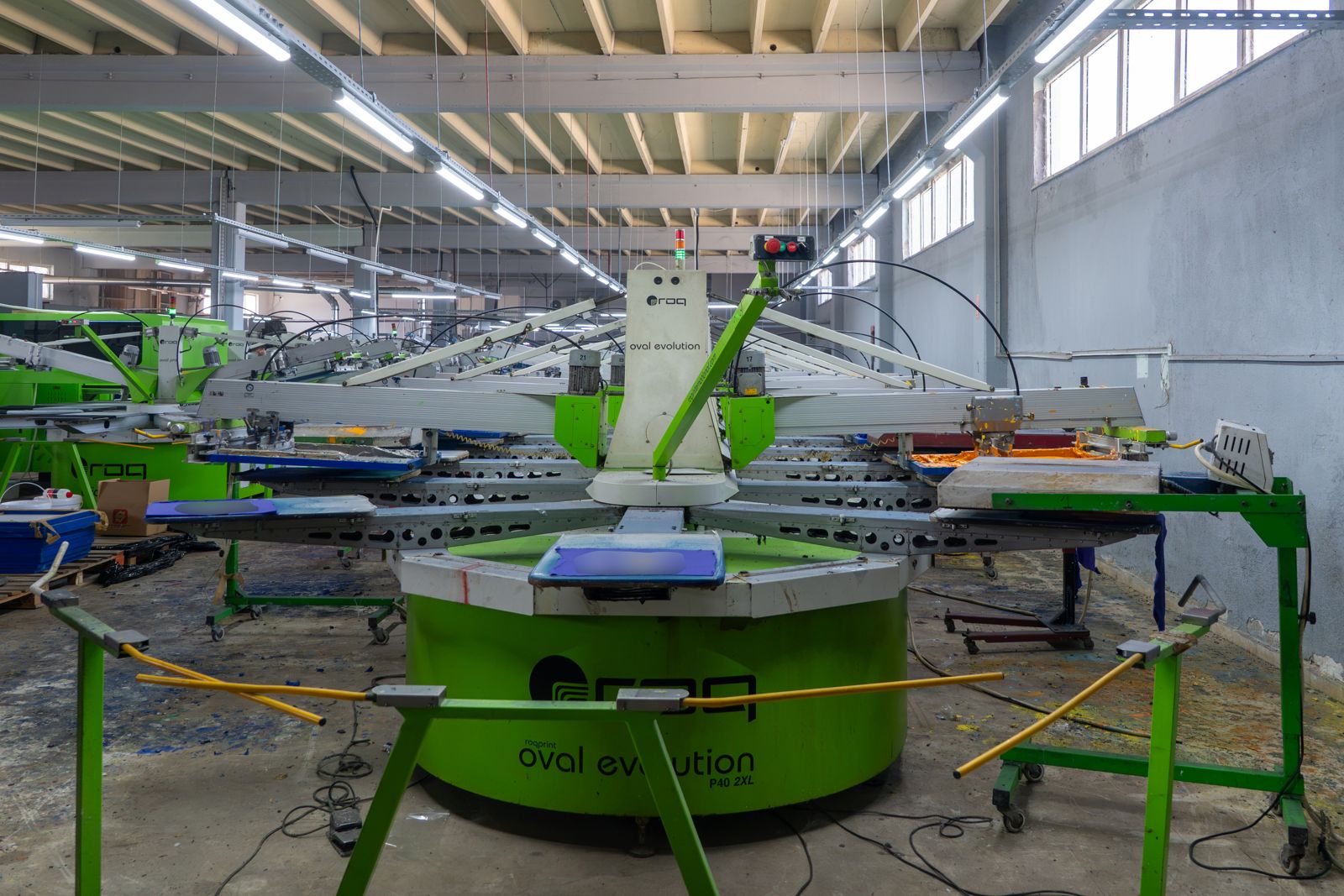
Screen printing is one of the most established textile printing methods.
In this process, ink is transferred onto the textile through a prepared mesh screen.
For multi-color artwork, individual colors generally require separate screens and accurate registration during production.
Although screen preparation requires additional setup, the method can become highly efficient when the same design is repeated across large quantities.
Advantages of Screen Printing
- Highly suitable for repetitive production
- Efficient for many high-volume projects
- Suitable for simple and bold graphics
- Works with a wide variety of textile ink systems
- Can produce strong and consistent colors
- Supports various specialty print effects depending on the production system
Screen printing remains particularly important for professional and industrial garment production.
5. Sublimation Printing
Sublimation printing uses heat to transfer specialized dyes into compatible synthetic materials.
Rather than creating a conventional layer of ink on top of the fabric, the dye becomes integrated with suitable polyester fibers during the sublimation process.
This makes sublimation particularly popular for certain polyester textile applications.
Advantages of Sublimation Printing
- Excellent for suitable polyester fabrics
- Supports full-color designs
- Suitable for photographic artwork
- Print becomes integrated with compatible fibers
- Widely used in sportswear and performance garments
However, sublimation is not a universal solution for every textile. Fabric composition and color are important factors when determining whether sublimation is appropriate.
Textile Printing Methods Comparison
| Method | Best For | Artwork | Fabric Considerations | Production |
|---|---|---|---|---|
| DTG | Detailed garment graphics | Full-color, detailed, photographic | Commonly cotton and cotton-rich | Digital direct printing |
| DTF | Versatile garment applications | Full-color and detailed | Broad textile compatibility | Film transfer |
| Hybrid DTG | Detailed designs and professional production | Complex, multi-color artwork | Depends on production system | Hybrid digital workflow |
| Screen Printing | Repetitive and high-volume production | Especially effective for defined-color graphics | Broad textile applications | Screen-based production |
| Sublimation | Polyester and performance textiles | Full-color and photographic | Primarily compatible polyester applications | Dye sublimation |
Which Textile Printing Method Has the Best Quality?
There is no single textile printing method that provides the best quality for every application.
Professional print quality depends on the relationship between:
- Fabric
- Artwork
- Printing technology
- Ink or transfer materials
- Production settings
- Curing or transfer conditions
- Quality control
Which Printing Method Is Best for T-Shirts?
DTG, DTF, Hybrid DTG and screen printing can all be used for professional T-shirt printing.
The correct method depends on the project.
For example:
- Detailed artwork on cotton garments: DTG may be appropriate.
- Different fabric compositions: DTF may provide greater flexibility.
- Complex designs at larger quantities: Hybrid DTG may be considered.
- Simple designs at high quantities: Screen printing can be highly efficient.
This is why professional T-shirt printing should begin with an evaluation of the garment, design and production quantity.
Which Printing Method Is Best for Cotton?
For cotton and cotton-rich garments, DTG and screen printing are widely used production methods.
DTF can also be applied to cotton, while Hybrid DTG may be considered for suitable professional production projects.
The best option depends on factors such as artwork complexity, quantity, desired print feel and production requirements.
Which Printing Method Is Best for Polyester?
Polyester requires different considerations from cotton.
Sublimation can be particularly effective for suitable polyester textiles, especially in sportswear and performance garment applications.
DTF can also provide flexibility for various synthetic garment applications.
However, polyester fabrics can differ significantly in construction, dyes, coatings and heat sensitivity. The actual textile should therefore be evaluated before production.
Digital Textile Printing vs Screen Printing
One of the major decisions in garment production is whether to use digital textile printing or conventional screen printing.
Digital technologies such as DTG provide considerable flexibility for complex, multi-color artwork.
Screen printing requires more physical preparation but can become highly efficient when the same artwork is repeated in large quantities.
Neither approach is universally better.
The decision should be based on the technical and commercial requirements of the project.
How Does Order Quantity Affect the Printing Method?
Production quantity can significantly influence the selection of a textile printing technology.
However, quantity should never be considered alone.
For example, a large order containing a simple one-color logo has very different production requirements from a large order containing a photographic graphic with many colors and gradients.
Therefore, manufacturers should evaluate both quantity and artwork complexity.
How Does Artwork Affect the Printing Method?
The characteristics of the artwork can be just as important as the fabric.
Important considerations include:
- Number of colors
- Gradients
- Photographic details
- Fine lines
- Print dimensions
- Ink coverage
- Number of print positions
Digital methods can provide significant flexibility for complex artwork, while screen printing can be highly effective for designs with clearly defined colors and repetitive production.
How to Choose the Right Textile Printing Method
Before selecting a printing technology, several factors should be evaluated together.
1. Fabric Composition
Determine whether the garment is cotton, polyester, blended or another textile material.
2. Artwork
Evaluate the number of colors, detail level, gradients and overall design complexity.
3. Order Quantity
Consider both the total quantity and the number of different designs within the order.
4. Garment Color
Dark and light garments may require different production stages depending on the printing technology.
5. Desired Print Feel
Different printing technologies interact with the textile surface differently, which can affect the final hand feel.
6. Intended Use
A fashion T-shirt, sports jersey, promotional garment and children's product may have different performance requirements.
7. Production Requirements
Sample development, consistency, finishing, packaging and delivery requirements should also be considered when planning production.
Why Is the Printing Method Important for Clothing Brands?
The print is an important part of the finished garment.
A high-quality garment combined with the wrong printing method can still produce an unsatisfactory final product.
For clothing brands, selecting the correct printing technology can influence:
- Visual quality
- Garment feel
- Wash performance
- Production consistency
- Production efficiency
- Overall product positioning
This makes textile printing an important production decision rather than simply a final decoration stage.
Should You Request a Sample Before Production?
For professional clothing production, creating a sample before bulk manufacturing is strongly recommended.
A physical sample allows the brand to evaluate:
- Actual print colors
- Detail reproduction
- Print size
- Print position
- Surface feel
- Fabric compatibility
- Overall garment appearance
Once approved, the sample can serve as a useful reference during production.
Textile Printing in Turkey
Turkey has a well-established textile and garment manufacturing industry serving both domestic and international clothing markets.
For international fashion brands sourcing from Turkey, access to different textile printing methods can make it easier to select production processes according to individual collections and garment types.
Instead of using one printing method for every product, professional production should evaluate each project according to its fabric, artwork, quantity and quality requirements.
How to Choose a Textile Printing Manufacturer
A professional textile printing supplier should be able to evaluate a project before recommending a production method.
When selecting a manufacturer, clothing brands should consider:
- Available printing technologies
- Textile experience
- Fabric knowledge
- Sample development
- Print consistency
- Quality control
- Ability to manage bulk production
- Communication and production planning
The cheapest printing method is not necessarily the most cost-effective solution if it does not provide the required quality or compatibility with the garment.
Professional Textile Printing with Efor Baskı
Efor Baskı provides professional textile printing solutions for clothing brands, textile manufacturers and garment production projects.
Different projects may require different printing technologies. The garment, fabric composition, artwork and production quantity should therefore be evaluated together before selecting a printing method.
Whether your project requires detailed digital artwork, bulk T-shirt production or professional garment printing, choosing the correct technology is an important part of achieving a consistent final product.
If you are looking for a textile printing manufacturer in Turkey, contact Efor Baskı to discuss your garments, artwork and production requirements.