
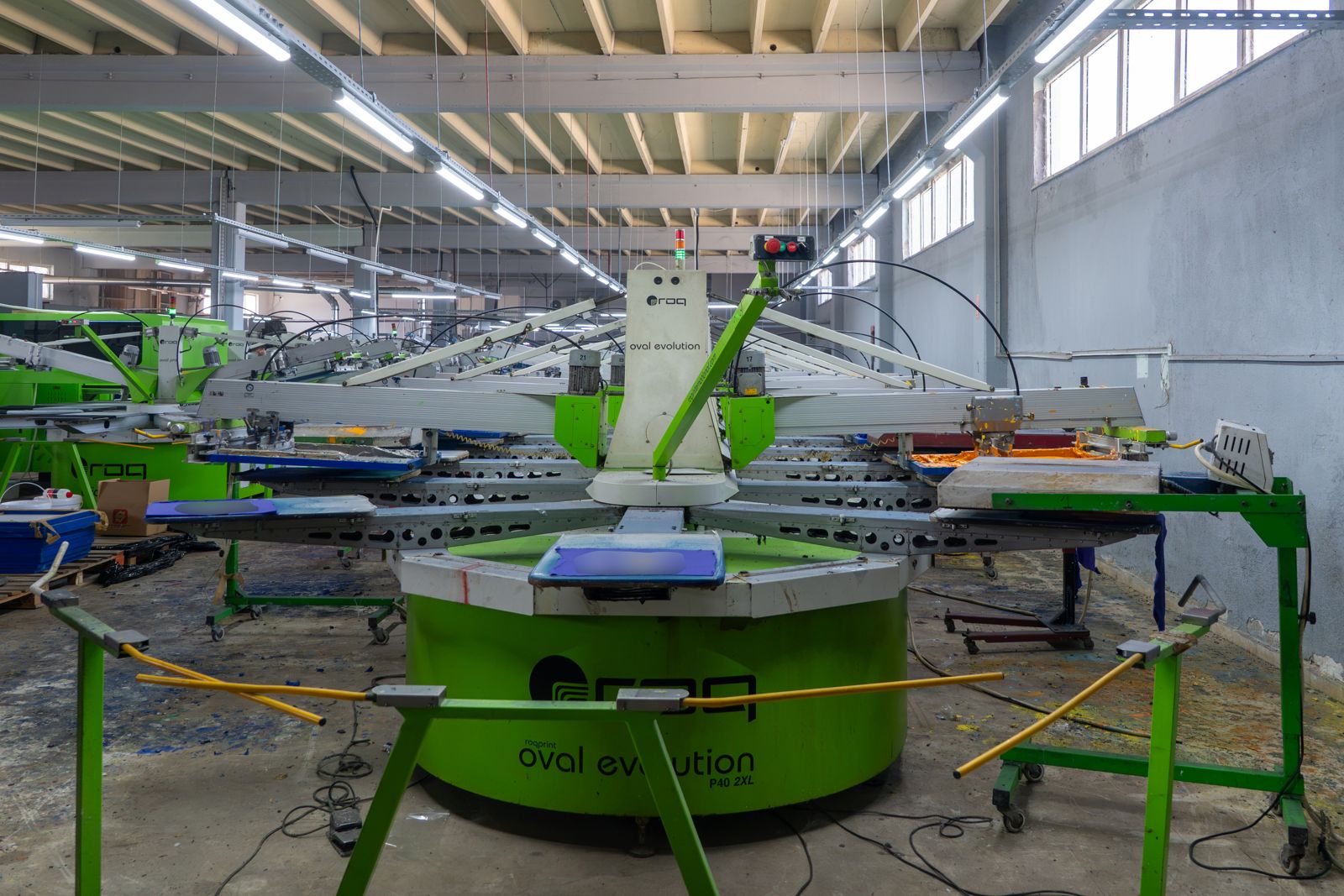
Screen printing is one of the most established and widely used printing methods in the textile and garment industry.
From T-shirts and sweatshirts to fashion collections, promotional garments and high-volume apparel production, screen printing is used across a wide range of textile applications.
The method works by transferring ink through a prepared mesh screen onto the textile surface.
One of the main advantages of screen printing is its efficiency when the same artwork needs to be reproduced across larger quantities of garments.
In this guide, we explain what screen printing is, how the process works, its advantages and how it compares with modern digital textile printing technologies.
What Is Screen Printing?
Screen printing is a printing technique in which ink is pushed through selected open areas of a mesh screen onto a textile or another printable surface.
A stencil controls which areas of the screen allow ink to pass through.
In textile production, the garment is positioned beneath the screen and ink is transferred through the mesh using a squeegee or automated printing system.
For multi-color designs, separate screens are generally prepared for individual colors.
How Does Screen Printing Work?
Professional textile screen printing involves several production stages.
A typical workflow includes:
- Artwork preparation
- Color separation
- Screen preparation
- Garment positioning
- Ink application
- Color registration
- Curing
- Quality control
1. Artwork Preparation
The process begins with preparing the artwork for production.
The design is evaluated according to:
- Print dimensions
- Number of colors
- Fine details
- Garment color
- Print position
- Required ink system
Correct artwork preparation is essential for achieving a consistent final result.
2. Color Separation
In conventional screen printing, multi-color artwork usually needs to be separated into individual printing colors.
Each separation represents a specific part of the artwork that will be printed through its own screen.
The complexity of this stage depends on the design.
A simple one-color logo requires a much simpler setup than an artwork containing multiple colors, gradients or detailed visual elements.
3. Screen Preparation
A mesh screen is prepared for each required print separation.
The screen is coated with a light-sensitive emulsion and exposed using the prepared artwork.
After processing, selected areas remain open in the mesh, allowing ink to pass through during printing.
This creates the stencil used to reproduce the design on the garment.
4. Garment Preparation and Positioning
The garment must be positioned accurately on the printing equipment.
Correct placement is particularly important for production consistency.
Professional printing requires control over:
- Horizontal positioning
- Vertical positioning
- Print angle
- Distance from garment seams
- Consistency between garments
5. Ink Application
Once the screen and garment are positioned, textile ink is applied to the screen.
A squeegee pushes the ink across the mesh, forcing it through the open areas of the stencil and onto the garment.
This process is repeated according to the requirements of the artwork.
6. Color Registration
For multi-color screen printing, each screen must align accurately with the others.
This process is known as registration.
Accurate registration ensures that different colors and elements of the artwork appear in the correct position.
Poor registration can result in visible misalignment between colors.
7. Curing the Print
After printing, the ink must be properly cured according to the requirements of the ink system.
Curing helps the print reach its intended performance characteristics.
Temperature, time and production conditions need to be controlled carefully.
Incorrect curing can negatively affect print durability and wash performance.
8. Quality Control
The final stage is quality control.
Printed garments can be checked for:
- Color consistency
- Print position
- Registration
- Print dimensions
- Ink coverage
- Visible production defects
Quality control becomes particularly important when producing large quantities of garments.
What Are the Advantages of Screen Printing?
Screen printing continues to be widely used because it offers several important production advantages.
Efficient for High-Volume Production
Once the screens and production line are prepared, the same artwork can be reproduced efficiently across a large number of garments.
This makes screen printing particularly suitable for repetitive bulk production.
Strong Color Reproduction
Screen printing can produce strong and consistent colors using suitable textile ink systems.
This can be particularly useful for bold graphics and brand colors.
Suitable for Different Textile Applications
Depending on the ink system and production process, screen printing can be used across various garment and textile applications.
Special Printing Effects
Screen printing can also support different specialty inks and print effects depending on the production system.
These can be used to create visual or tactile characteristics that differ from conventional flat printing.
What Products Can Be Screen Printed?
Textile screen printing can be used for many different garment categories.
Common applications include:
- T-shirts
- Sweatshirts
- Hoodies
- Fashion garments
- Streetwear
- Promotional clothing
- Corporate apparel
- Various textile products
Screen Printing for T-Shirts
T-shirt screen printing is one of the most common applications of this technology.
The method is particularly effective when the same design needs to be printed across larger quantities.
For example, a simple logo or graphic using a limited number of colors may be highly suitable for screen printing.
For a broader overview of professional T-shirt production, see our T-Shirt Printing Guide.
Which Fabrics Can Be Screen Printed?
Screen printing can be used on a wide variety of textile materials when the appropriate ink system and production process are selected.
Common examples include:
- Cotton
- Cotton-rich blends
- Polyester
- Various blended fabrics
However, fabric composition, surface structure, dyes and garment treatments can influence the printing process.
The actual textile should therefore be evaluated before bulk production.
Is Screen Printing Durable?
Screen printing can provide excellent durability when the correct ink, fabric compatibility and curing conditions are used.
Print performance depends on several factors:
- Ink system
- Fabric composition
- Ink coverage
- Curing temperature
- Curing time
- Garment washing conditions
- Overall production quality
Correct curing is particularly important for achieving reliable wash performance.
Screen Printing vs DTG Printing
Screen printing and DTG use very different production methods.
DTG prints artwork digitally and directly onto the garment, while screen printing uses prepared mesh screens to transfer ink.
| Feature | Screen Printing | DTG Printing |
|---|---|---|
| Production Method | Screen-based | Digital direct printing |
| Simple Designs | Excellent | Suitable |
| Photographic Artwork | Requires more advanced preparation | Highly suitable |
| Multiple Colors | Usually requires additional screens | Digital color workflow |
| High-Volume Repetition | Highly efficient | Depends on production requirements |
| Artwork Changes | May require new screens | Digital files can be changed more easily |
For more information about digital direct printing, read our DTG Printing guide.
Screen Printing vs DTF Printing
DTF is a transfer-based process, while screen printing transfers ink directly through a mesh screen onto the garment.
DTF can provide flexibility for detailed, multi-color designs and different textile materials.
Screen printing can be highly efficient when larger quantities of the same artwork are required.
The correct choice depends on the fabric, artwork, quantity, desired print characteristics and production requirements.
You can learn more about digital and transfer technologies in our DTG vs DTF Printing comparison.
Screen Printing vs Hybrid DTG
Hybrid DTG combines conventional textile production stages with digital printing technology.
This can make it particularly useful for detailed and multi-color graphics at professional production quantities.
Screen printing, on the other hand, can be especially efficient when a relatively simple design is repeated across large quantities.
The decision should therefore be based on both artwork complexity and production volume.
Read our Hybrid DTG Printing guide for more information.
Why Is Screen Printing Suitable for Bulk Production?
Screen printing requires preparation before production begins.
Screens need to be created, colors prepared and the printing equipment configured.
However, once this setup is complete, the same artwork can be reproduced efficiently across many garments.
For this reason, the setup cost can become more efficient per garment as production quantity increases.
How Many Colors Can Be Used in Screen Printing?
Screen printing is not limited to one or two colors.
Multi-color designs can be produced by using multiple screens and accurate color registration.
However, each additional color can increase:
- Screen preparation
- Registration requirements
- Production complexity
- Setup time
For designs containing many colors, gradients or photographic details, digital technologies may sometimes provide a more practical production workflow.
Can Special Effects Be Created with Screen Printing?
Yes. One of the advantages of screen printing is its compatibility with various specialty textile inks and production techniques.
Depending on the printing system, different effects can be created to provide additional visual or tactile characteristics.
The availability and suitability of these effects should be evaluated according to the garment and project requirements.
What Affects Screen Printing Prices?
The cost of professional screen printing depends on multiple factors.
These can include:
- Order quantity
- Number of print colors
- Number of required screens
- Print dimensions
- Number of print positions
- Fabric type
- Garment color
- Ink requirements
- Special effects
- Finishing requirements
Because every project is different, accurate pricing should be based on the actual artwork and garment specifications.
Should You Request a Screen Printing Sample?
For clothing brands and bulk production projects, a sample is recommended before full production.
A physical sample makes it possible to evaluate:
- Actual print colors
- Print dimensions
- Placement
- Registration
- Ink coverage
- Surface feel
- Overall appearance
Once approved, the sample can be used as a production reference.
Who Should Choose Screen Printing?
Screen printing may be particularly suitable for:
- Clothing brands producing larger quantities
- Streetwear brands
- Promotional garment projects
- Corporate apparel
- Retail collections
- Textile manufacturers
- Projects requiring repeated production of the same artwork
However, screen printing is only one of several professional textile printing technologies.
Our Textile Printing Methods guide compares the main options available for garment production.
Screen Printing in Turkey
Turkey has an established textile and apparel manufacturing industry serving domestic and international clothing brands.
Professional screen printing in Turkey can be integrated into garment manufacturing workflows for fashion, streetwear, promotional clothing and bulk textile production.
For international brands, working with an experienced textile printing manufacturer can help coordinate artwork preparation, sampling, production and quality control.
Professional Screen Printing with Efor Baskı
Efor Baskı provides professional textile printing solutions for clothing brands, textile manufacturers and garment production projects.
Depending on the artwork, garment, fabric and production quantity, screen printing or alternative textile printing technologies can be evaluated to determine an appropriate production method.
For bulk production, fashion collections or professional T-shirt screen printing in Turkey, contact Efor Baskı to discuss your project requirements.